commonsense
Member #072
Thought the members might be interested in my progress getting my Superformance running properly. I've owned it about 9 months and there were lots of little things to straighten out. The big thing is optimizing the engine.
It has a Roush 427R, single plane intake manifold, 351 Windsor, bored and stoked to 427 cubic inches. Originally, it left Roush as a 427SR which means it had a dual plane intake manifold. But it was unpolished and someone, who was more concerned with the looks, decided to change it. They put a polished Victor Jr. Edelbrock single plane manifold on it.
Originally, according to Roush, my engine dyno'd at 516 hp on their engine dyno. Roush's dynos, by the way, are certified monthly to be within 2% of Fords dynos. Ford comes in and checks them. I took it to Performance by Joe (on Hampton), a tuner I know and trust and IMHO, the best tuner in St. Louis. He's done 3 cars for me and made more than 10,000 pulls on his Dynojet dynamometer. There's usually a six week wait to get in to see him. That's because it's worth it.
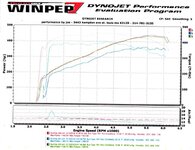
My initial pull showed only 365 hp and 398 ft lbs of torque, at the rear wheels. And it was way too rich up top. I'll try to attach the report. This is obviously very disappointing. At the rear wheels, it should have shown something like 420 to 440 hp. Joe and I talked about it and I decided to change the distributor and rejet it. I made an appointment for six weeks later.
The idiot who changed the manifold (as it turns out) changed the distributor, because the one Roush fitted wouldn't clear the taller single plane manifold. He stuck on a vacuum advance MSD that had no mechanical advance (probably from a race engine). Yeah, it fit, but the timing was a joke.
Second problem was when he changed the manifold, the carburetor no longer worked properly. Long story short, it now has a double pumper 750 Holley, which I rejetted. The best jetting is 75 primaries and 78 secondaries. I put a 5.0 power valve in it.
I ordered a new MSD distributor, made specially to go with the Victor Jr. manifold (on the 351W) and checked total advance stop and advance springs. I set it to 13 degrees initial advance. The advance stop is set to 21 degrees. So, total advance is now 34 degrees, which is what Roush recommends.
A visit to Joe and the first pull this time resulted in a bunch more hp and torque, but it was now too lean--probably because it was now getting the spark at the right time. He told me to go up three sizes on the primary and two sizes on the secondaries. Next pull, it was perfect. Almost perfectly matching 12.7 to one Air/Fuel ratio all the way up. Horsepower was now up almost 80 hp to 443 at the rear wheels. Torque was up 55 ft lbs to 454 at the rear wheel. Needless to say, I'm thrilled. According to Joe's calculator, for a Tremec, this translates to about 510 hp at the crank.
Yes, I have a single plane manifold, which now makes it a 427R, instead of a 427SR. 427R's are supposed to be 550 hp. While 427SR's are 510 hp. However, Roush tells me that the dual plane engines have a different cam, which makes more low end torque. My engine now makes more than 420 ft lbs of torque (at the wheels), all the way from 2700 RPM to 5500RPM. This is more than 500 ft lbs at the engine. So, I'm guessing that my engine splits the difference between a 427R and 427SR. More low end torque than the 427R and more horsepower than the 427SR. I'm happy with the additional low end torque.
Lessons learned? Vacuum advance distributors--in this day and age--are not necessary In the old days, distributors had to have both vacuum advance and mechanical advance to bridge the necessary wide timing gap. Weak, pre transistorized ignitions needed very low advance so engines would start. And vacuum advance wouldn't give enough for total full advance. So, they transitioned to mechanical advance. If I remember correctly, 'back in the day' initial advance, on a lot of engines, was something like 6 to 8 degrees BTDC. But today, with powerful ignitions, engines start happily at 13 to 16 degrees BTDC. So, all you need is a mechanical advance. These don't stick like vacuum advance systems, and are not subject to leaks. They're also adjustable. If you have a vacuum advance distributor, I would recommend changing it to mechanical advance only.
Second lesson? Have Joe Donovan tune your engine. My cost for the initial pull was $50, which includes Air/Fuel. The second session was $100. Joe knows what he's doing and so requires a bare minimum of time and changes to optimize the engine.
It has a Roush 427R, single plane intake manifold, 351 Windsor, bored and stoked to 427 cubic inches. Originally, it left Roush as a 427SR which means it had a dual plane intake manifold. But it was unpolished and someone, who was more concerned with the looks, decided to change it. They put a polished Victor Jr. Edelbrock single plane manifold on it.
Originally, according to Roush, my engine dyno'd at 516 hp on their engine dyno. Roush's dynos, by the way, are certified monthly to be within 2% of Fords dynos. Ford comes in and checks them. I took it to Performance by Joe (on Hampton), a tuner I know and trust and IMHO, the best tuner in St. Louis. He's done 3 cars for me and made more than 10,000 pulls on his Dynojet dynamometer. There's usually a six week wait to get in to see him. That's because it's worth it.
My initial pull showed only 365 hp and 398 ft lbs of torque, at the rear wheels. And it was way too rich up top. I'll try to attach the report. This is obviously very disappointing. At the rear wheels, it should have shown something like 420 to 440 hp. Joe and I talked about it and I decided to change the distributor and rejet it. I made an appointment for six weeks later.
The idiot who changed the manifold (as it turns out) changed the distributor, because the one Roush fitted wouldn't clear the taller single plane manifold. He stuck on a vacuum advance MSD that had no mechanical advance (probably from a race engine). Yeah, it fit, but the timing was a joke.
Second problem was when he changed the manifold, the carburetor no longer worked properly. Long story short, it now has a double pumper 750 Holley, which I rejetted. The best jetting is 75 primaries and 78 secondaries. I put a 5.0 power valve in it.
I ordered a new MSD distributor, made specially to go with the Victor Jr. manifold (on the 351W) and checked total advance stop and advance springs. I set it to 13 degrees initial advance. The advance stop is set to 21 degrees. So, total advance is now 34 degrees, which is what Roush recommends.
A visit to Joe and the first pull this time resulted in a bunch more hp and torque, but it was now too lean--probably because it was now getting the spark at the right time. He told me to go up three sizes on the primary and two sizes on the secondaries. Next pull, it was perfect. Almost perfectly matching 12.7 to one Air/Fuel ratio all the way up. Horsepower was now up almost 80 hp to 443 at the rear wheels. Torque was up 55 ft lbs to 454 at the rear wheel. Needless to say, I'm thrilled. According to Joe's calculator, for a Tremec, this translates to about 510 hp at the crank.
Yes, I have a single plane manifold, which now makes it a 427R, instead of a 427SR. 427R's are supposed to be 550 hp. While 427SR's are 510 hp. However, Roush tells me that the dual plane engines have a different cam, which makes more low end torque. My engine now makes more than 420 ft lbs of torque (at the wheels), all the way from 2700 RPM to 5500RPM. This is more than 500 ft lbs at the engine. So, I'm guessing that my engine splits the difference between a 427R and 427SR. More low end torque than the 427R and more horsepower than the 427SR. I'm happy with the additional low end torque.
Lessons learned? Vacuum advance distributors--in this day and age--are not necessary In the old days, distributors had to have both vacuum advance and mechanical advance to bridge the necessary wide timing gap. Weak, pre transistorized ignitions needed very low advance so engines would start. And vacuum advance wouldn't give enough for total full advance. So, they transitioned to mechanical advance. If I remember correctly, 'back in the day' initial advance, on a lot of engines, was something like 6 to 8 degrees BTDC. But today, with powerful ignitions, engines start happily at 13 to 16 degrees BTDC. So, all you need is a mechanical advance. These don't stick like vacuum advance systems, and are not subject to leaks. They're also adjustable. If you have a vacuum advance distributor, I would recommend changing it to mechanical advance only.
Second lesson? Have Joe Donovan tune your engine. My cost for the initial pull was $50, which includes Air/Fuel. The second session was $100. Joe knows what he's doing and so requires a bare minimum of time and changes to optimize the engine.